{ THIBAUT. DESGLAND }
<
WORK
>
<
ABOUT
>
<
CONTACT
>
<
MENU
>
VESTIAIRE CO.
PRE-LOVED FASHION YOU CAN TRUST
CONTEXT
As part of a product design bootcamp with The Design Crew, Vestiaire Collective came with the following challenge: How might we help our sellers manage their inventory more efficiently and maximize their sales potential? I was given a 2-week sprint to answer as a solo designer, handling the full end-to-end process from user research, through ideation and prototyping, to testing and refinement.
TYPE
Product Design
YEAR
2026


VESTIAIRE COLLECTIVE
Vestiaire Collective is a peer-to-peer fashion marketplace where individuals buy and sell pre-owned clothing, accessories, and luxury items. Founded in 2009, the platform connects millions of sellers and buyers globally, offering an alternative to traditional retail with a focus on sustainability and accessibility to high-end fashion.
VESTIAIRE COLLECTIVE
Vestiaire Collective is a peer-to-peer fashion marketplace where individuals buy and sell pre-owned clothing, accessories, and luxury items. Founded in 2009, the platform connects millions of sellers and buyers globally, offering an alternative to traditional retail with a focus on sustainability and accessibility to high-end fashion.


USER INTERVIEWS
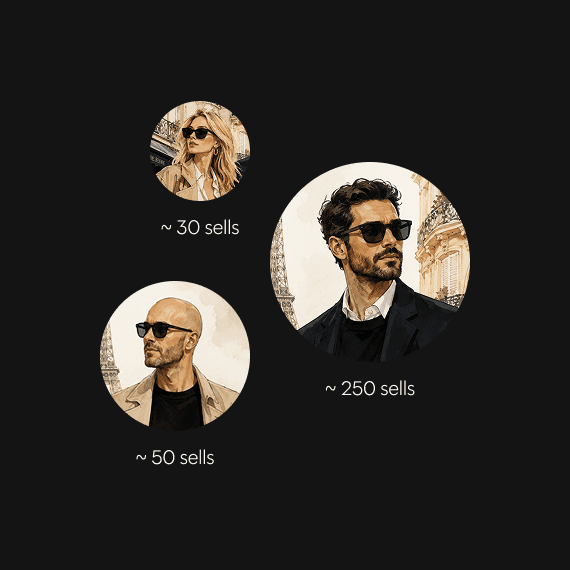
I conducted 45 min interviews with three sellers to uncover three key areas: their relationship with pricing decisions, how they manage and update listings, and how they handle price negotiations with buyers.
USER INTERVIEWS
I conducted 45 min interviews with three sellers to uncover three key areas: their relationship with pricing decisions, how they manage and update listings, and how they handle price negotiations with buyers.
LEARNINGS
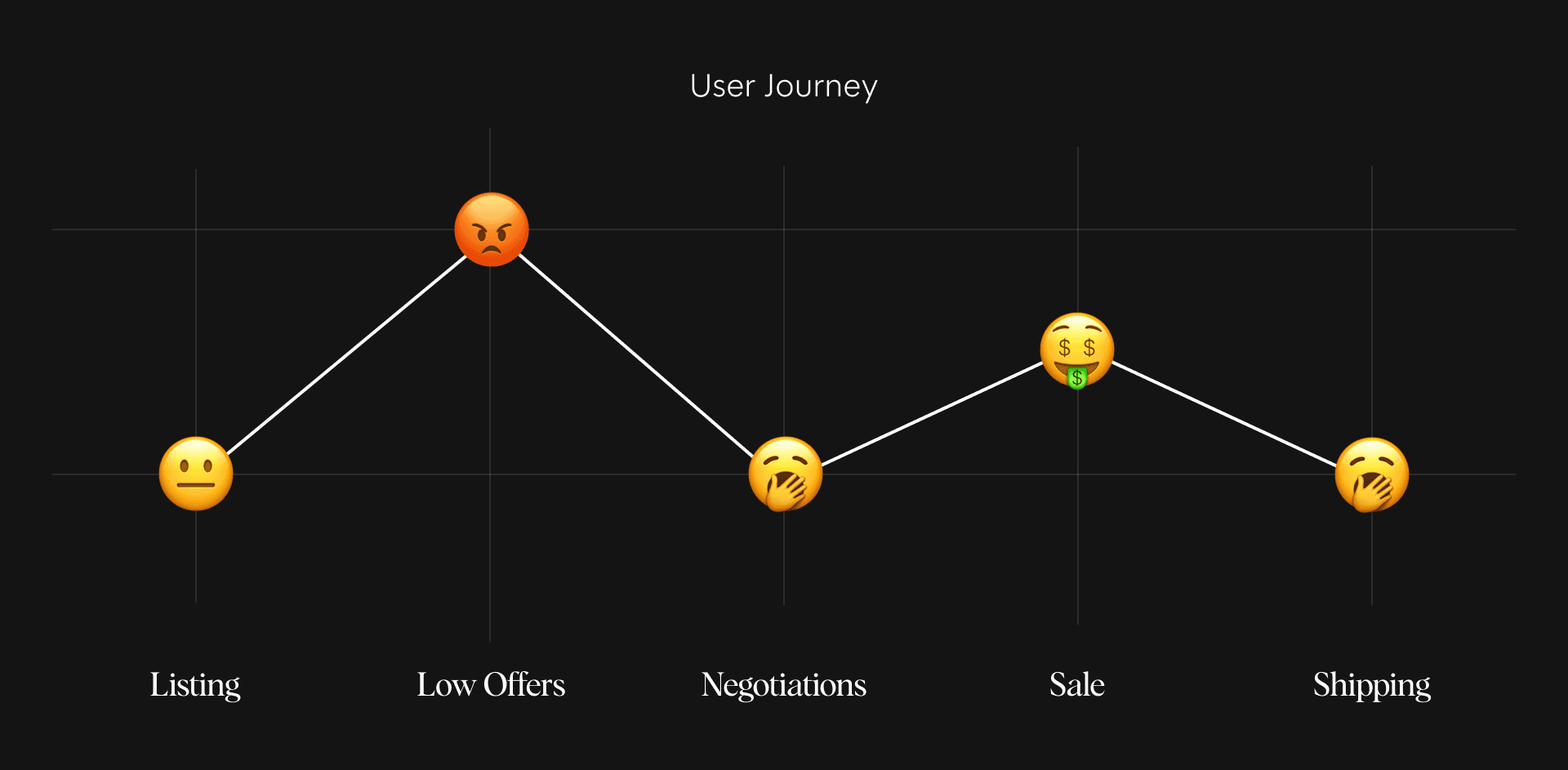
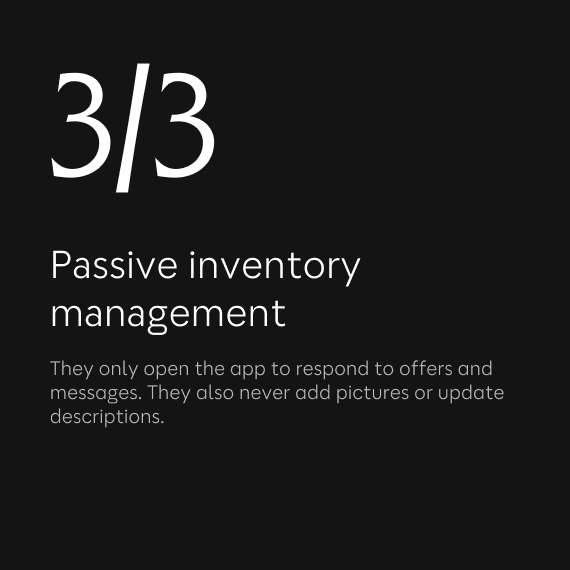
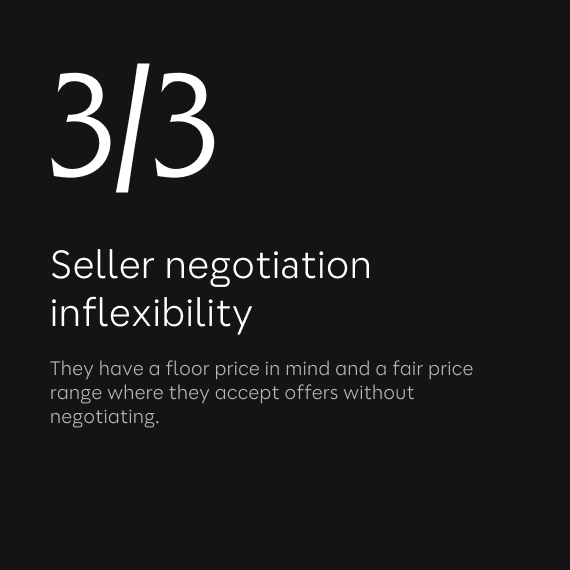
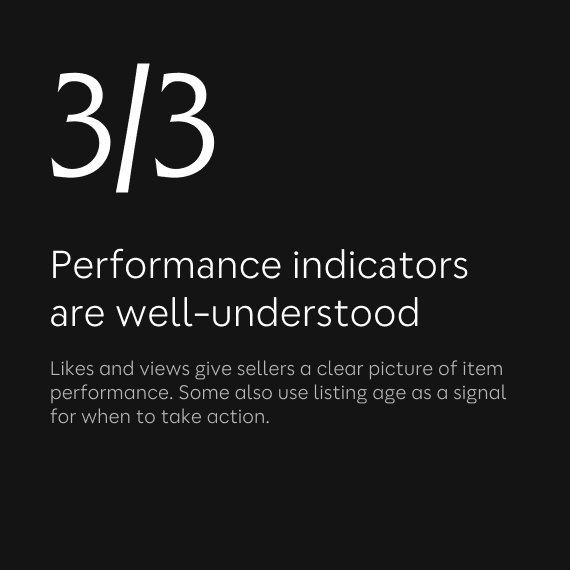
Through interviews with three active sellers and data from power users, I uncovered a pattern: sellers manage listings passively, posting and waiting rather than optimizing. While performance metrics were well-understood, they resisted lowering prices upfront, preferring to relist instead. The key insight: they entered the listing flow with clear internal price anchors (a floor price and an acceptance range) but this knowledge never made it into the product. Meanwhile, power sellers complained about fragmented UX: no bulk edits, no bundling, listings scattered across views.
LEARNINGS
Through interviews with three active sellers and data from power users, I uncovered a pattern: sellers manage listings passively, posting and waiting rather than optimizing. While performance metrics were well-understood, they resisted lowering prices upfront, preferring to relist instead. The key insight: they entered the listing flow with clear internal price anchors (a floor price and an acceptance range) but this knowledge never made it into the product. Meanwhile, power sellers complained about fragmented UX: no bulk edits, no bundling, listings scattered across views.
SOLUTIONS
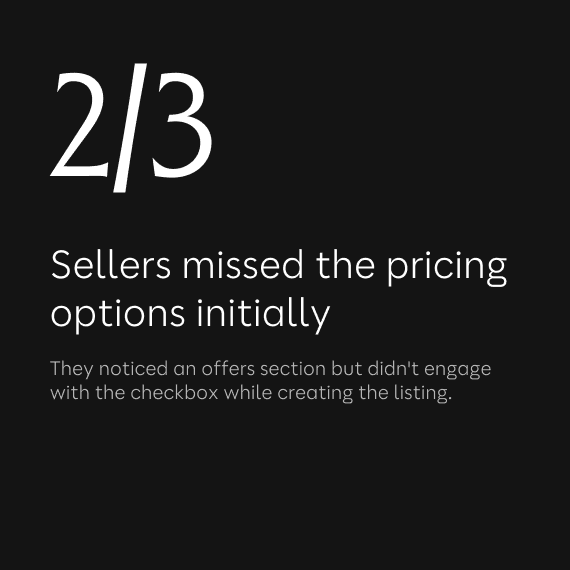
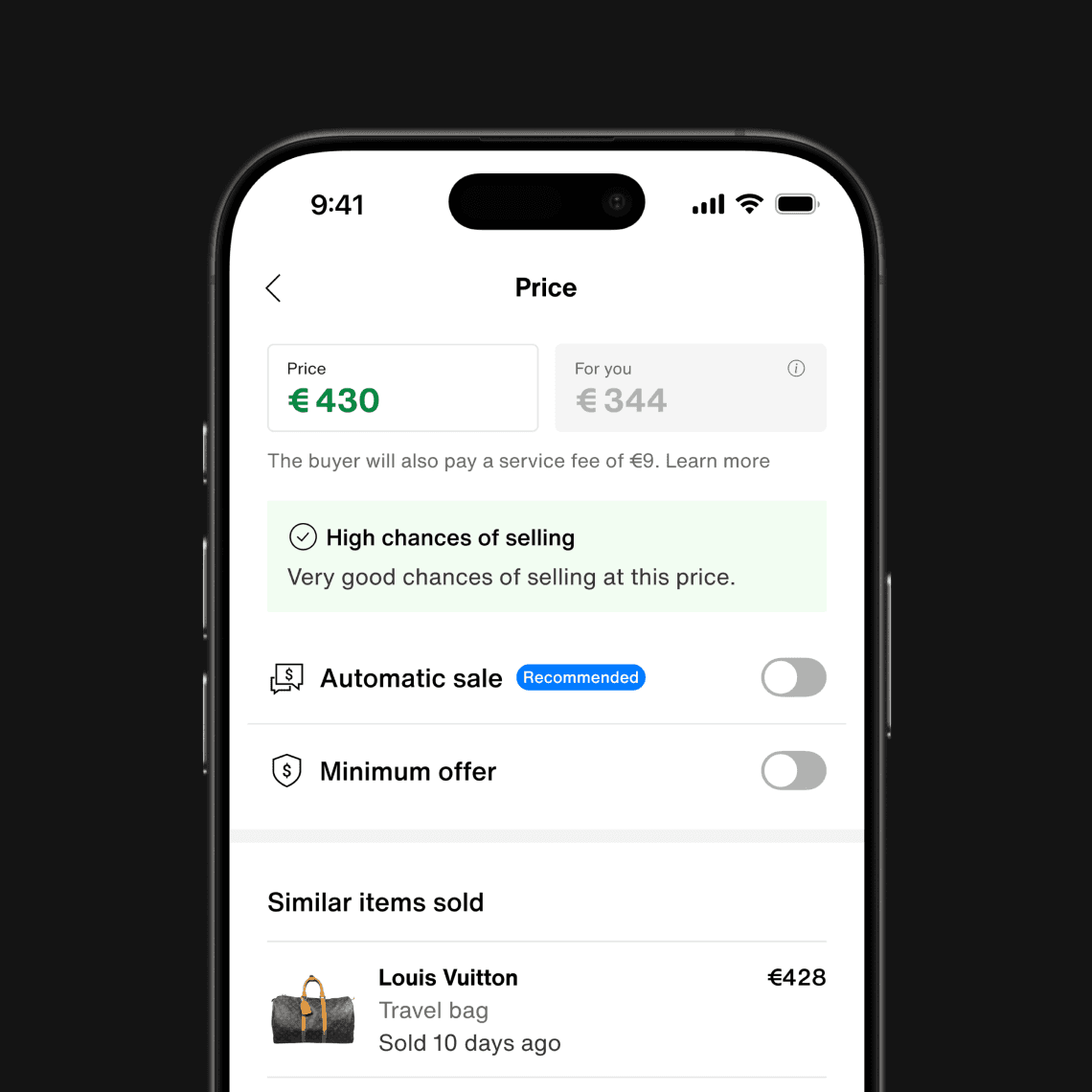
Within the pricing configuration, I introduced floor price and auto-accept checkbox, plus an option to disable offers completely to test whether sellers preferred a fixed-price model over negotiation.
SOLUTIONS
Within the pricing configuration, I introduced floor price and auto-accept checkbox, plus an option to disable offers completely to test whether sellers preferred a fixed-price model over negotiation.
PRICING OPTIONS
Within the pricing configuration, I introduced floor price and auto-accept checkbox, plus an option to disable offers completely to test whether sellers preferred a fixed-price model over negotiation.
PRICING OPTIONS
Within the pricing configuration, I introduced floor price and auto-accept checkbox, plus an option to disable offers completely to test whether sellers preferred a fixed-price model over negotiation.
BUNDLES
I gave sellers the ability to offer a price reduction when buyers purchase multiple items from their inventory. The feature is introduced through a bottom sheet on the Sell tab, with options to set it up now or skip for later.
BUNDLES
I gave sellers the ability to offer a price reduction when buyers purchase multiple items from their inventory. The feature is introduced through a bottom sheet on the Sell tab, with options to set it up now or skip for later.
LISTING BOOST
I replaced the low-priority "Add picture" button with a listing boost feature priced below the discount sellers would typically apply. The flow allows sellers to add multiple items to boost before the checkout.
LISTING BOOST
I replaced the low-priority "Add picture" button with a listing boost feature priced below the discount sellers would typically apply. The flow allows sellers to add multiple items to boost before the checkout.
BULK PRICE REDUCTION
After selecting multiple items, this screen allows sellers to apply a percentage-based discount across all selected items at once. Using percentages lets sellers instantly calculate their margin impact without manual computation.
BULK PRICE REDUCTION
After selecting multiple items, this screen allows sellers to apply a percentage-based discount across all selected items at once. Using percentages lets sellers instantly calculate their margin impact without manual computation.
USER TESTS
Within the pricing configuration, I introduced floor price and auto-accept checkbox, plus an option to disable offers completely to test whether sellers preferred a fixed-price model over negotiation.
USER TESTS
Within the pricing configuration, I introduced floor price and auto-accept checkbox, plus an option to disable offers completely to test whether sellers preferred a fixed-price model over negotiation.

BUNDLE PUSH
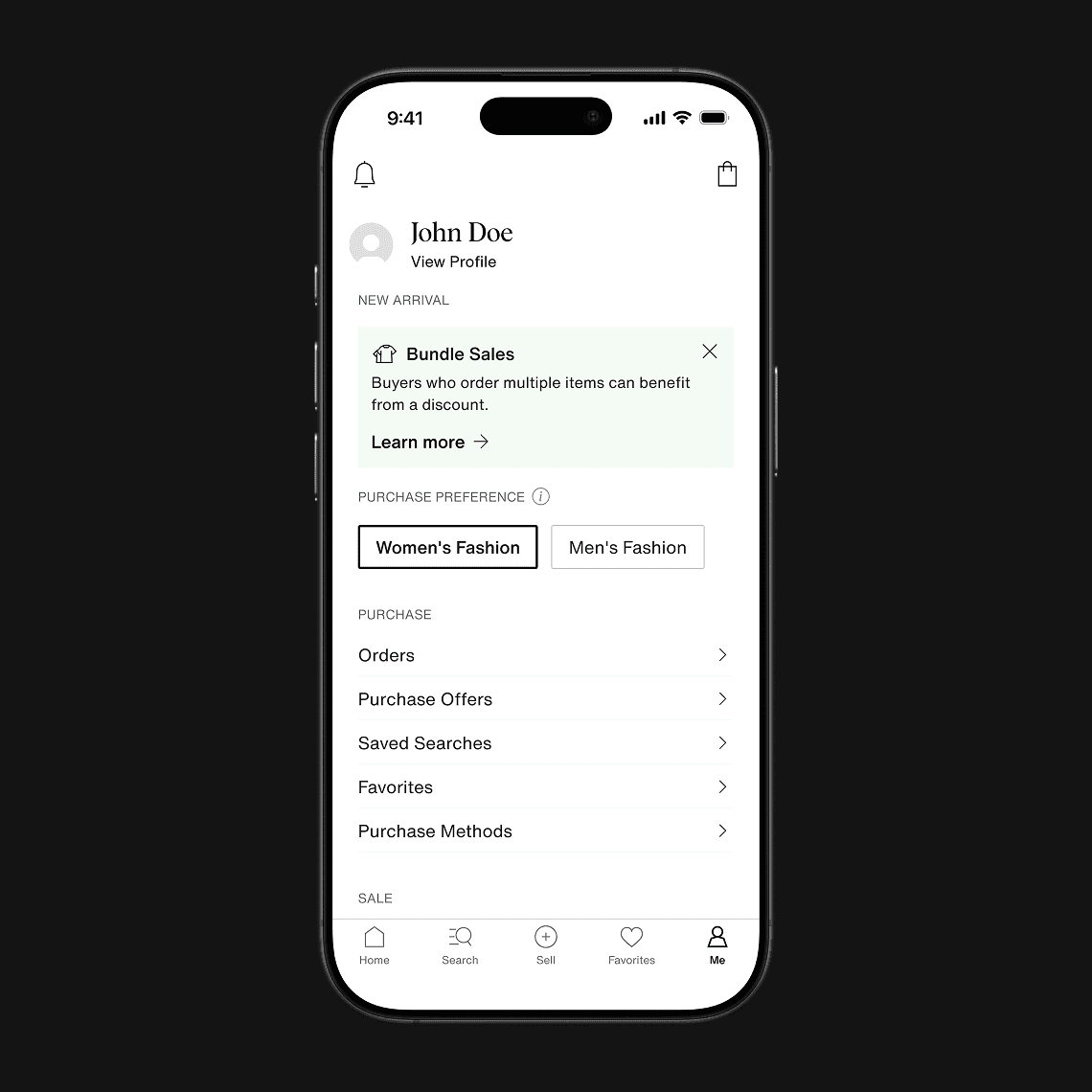
Since all users skipped the informational modal about the Bundles feature, I decided to adopt a less aggressive approach to announce the new feature by using a card in the "Me" tab, as users will necessarily see it when managing their listings.
BUNDLE PUSH
Since all users skipped the informational modal about the Bundles feature, I decided to adopt a less aggressive approach to announce the new feature by using a card in the "Me" tab, as users will necessarily see it when managing their listings.

PRICING OPTIONS AFFORDANCE
To make pricing options more visible and understandable, I added two icons and a "Recommended" badge. I also simplified the whole section by removing the "Allow offer" toggle and changing the wording to make automatic acceptance clearer.
PRICING OPTIONS AFFORDANCE
To make pricing options more visible and understandable, I added two icons and a "Recommended" badge. I also simplified the whole section by removing the "Allow offer" toggle and changing the wording to make automatic acceptance clearer.

BULK ACTIONS AFFORDANCE
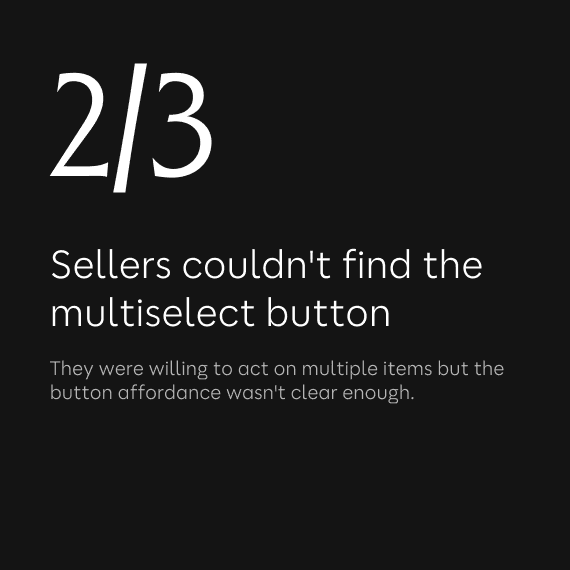
To make it clearer for sellers that they can boost items or lower prices on multiple items, I decided to remove the classic "Select" button and replace it with two quick action buttons that trigger multiselection. To do this, I simplified the filters by only keeping search and reordering.
BULK ACTIONS AFFORDANCE
To make it clearer for sellers that they can boost items or lower prices on multiple items, I decided to remove the classic "Select" button and replace it with two quick action buttons that trigger multiselection. To do this, I simplified the filters by only keeping search and reordering.


NEXT PROJECT
TITRE DU CASE
NEXT PROJECT
TITRE DU CASE
{ THIBAUT. DESGLAND }
<
WORK
>
<
ABOUT
>
<
CONTACT
>
<
MENU
>
VESTIAIRE CO.
PRE-LOVED FASHION YOU CAN TRUST
CONTEXT
As part of a product design bootcamp with The Design Crew, Vestiaire Collective came with the following challenge: How might we help our sellers manage their inventory more efficiently and maximize their sales potential? I was given a 2-week sprint to answer as a solo designer, handling the full end-to-end process from user research, through ideation and prototyping, to testing and refinement.
TYPE
Product Design
YEAR
2026
VESTIAIRE COLLECTIVE
Vestiaire Collective is a peer-to-peer fashion marketplace where individuals buy and sell pre-owned clothing, accessories, and luxury items. Founded in 2009, the platform connects millions of sellers and buyers globally, offering an alternative to traditional retail with a focus on sustainability and accessibility to high-end fashion.
USER INTERVIEWS
I conducted 45 min interviews with three sellers to uncover three key areas: their relationship with pricing decisions, how they manage and update listings, and how they handle price negotiations with buyers.
LEARNINGS
Through interviews with three active sellers and data from power users, I uncovered a pattern: sellers manage listings passively, posting and waiting rather than optimizing. While performance metrics were well-understood, they resisted lowering prices upfront, preferring to relist instead. The key insight: they entered the listing flow with clear internal price anchors (a floor price and an acceptance range) but this knowledge never made it into the product. Meanwhile, power sellers complained about fragmented UX: no bulk edits, no bundling, listings scattered across views.
SOLUTIONS
Within the pricing configuration, I introduced floor price and auto-accept checkbox, plus an option to disable offers completely to test whether sellers preferred a fixed-price model over negotiation.
PRICING OPTIONS
Within the pricing configuration, I introduced floor price and auto-accept checkbox, plus an option to disable offers completely to test whether sellers preferred a fixed-price model over negotiation.
BUNDLES
I gave sellers the ability to offer a price reduction when buyers purchase multiple items from their inventory. The feature is introduced through a bottom sheet on the Sell tab, with options to set it up now or skip for later.
LISTING BOOST
I replaced the low-priority "Add picture" button with a listing boost feature priced below the discount sellers would typically apply. The flow allows sellers to add multiple items to boost before the checkout.
BULK PRICE REDUCTION
After selecting multiple items, this screen allows sellers to apply a percentage-based discount across all selected items at once. Using percentages lets sellers instantly calculate their margin impact without manual computation.
USER TESTS
Within the pricing configuration, I introduced floor price and auto-accept checkbox, plus an option to disable offers completely to test whether sellers preferred a fixed-price model over negotiation.
BUNDLE PUSH
Since all users skipped the informational modal about the Bundles feature, I decided to adopt a less aggressive approach to announce the new feature by using a card in the "Me" tab, as users will necessarily see it when managing their listings.
PRICING OPTIONS AFFORDANCE
To make pricing options more visible and understandable, I added two icons and a "Recommended" badge. I also simplified the whole section by removing the "Allow offer" toggle and changing the wording to make automatic acceptance clearer.
BULK ACTIONS AFFORDANCE
To make it clearer for sellers that they can boost items or lower prices on multiple items, I decided to remove the classic "Select" button and replace it with two quick action buttons that trigger multiselection. To do this, I simplified the filters by only keeping search and reordering.
NEXT PROJECT
TITRE DU CASE
{ THIBAUT. DESGLAND }
<
WORK
>
<
ABOUT
>
<
CONTACT
>
<
MENU
>
VESTIAIRE CO.
PRE-LOVED FASHION YOU CAN TRUST
CONTEXT
As part of a product design bootcamp with The Design Crew, Vestiaire Collective came with the following challenge: How might we help our sellers manage their inventory more efficiently and maximize their sales potential? I was given a 2-week sprint to answer as a solo designer, handling the full end-to-end process from user research, through ideation and prototyping, to testing and refinement.
TYPE
Product Design
YEAR
2026
VESTIAIRE COLLECTIVE
Vestiaire Collective is a peer-to-peer fashion marketplace where individuals buy and sell pre-owned clothing, accessories, and luxury items. Founded in 2009, the platform connects millions of sellers and buyers globally, offering an alternative to traditional retail with a focus on sustainability and accessibility to high-end fashion.
USER INTERVIEWS
I conducted 45 min interviews with three sellers to uncover three key areas: their relationship with pricing decisions, how they manage and update listings, and how they handle price negotiations with buyers.
LEARNINGS
Through interviews with three active sellers and data from power users, I uncovered a pattern: sellers manage listings passively, posting and waiting rather than optimizing. While performance metrics were well-understood, they resisted lowering prices upfront, preferring to relist instead. The key insight: they entered the listing flow with clear internal price anchors (a floor price and an acceptance range) but this knowledge never made it into the product. Meanwhile, power sellers complained about fragmented UX: no bulk edits, no bundling, listings scattered across views.
SOLUTIONS
Within the pricing configuration, I introduced floor price and auto-accept checkbox, plus an option to disable offers completely to test whether sellers preferred a fixed-price model over negotiation.
PRICING OPTIONS
Within the pricing configuration, I introduced floor price and auto-accept checkbox, plus an option to disable offers completely to test whether sellers preferred a fixed-price model over negotiation.
BUNDLES
I gave sellers the ability to offer a price reduction when buyers purchase multiple items from their inventory. The feature is introduced through a bottom sheet on the Sell tab, with options to set it up now or skip for later.
LISTING BOOST
I replaced the low-priority "Add picture" button with a listing boost feature priced below the discount sellers would typically apply. The flow allows sellers to add multiple items to boost before the checkout.
BULK PRICE REDUCTION
After selecting multiple items, this screen allows sellers to apply a percentage-based discount across all selected items at once. Using percentages lets sellers instantly calculate their margin impact without manual computation.
USER TESTS
Within the pricing configuration, I introduced floor price and auto-accept checkbox, plus an option to disable offers completely to test whether sellers preferred a fixed-price model over negotiation.
BUNDLE PUSH
Since all users skipped the informational modal about the Bundles feature, I decided to adopt a less aggressive approach to announce the new feature by using a card in the "Me" tab, as users will necessarily see it when managing their listings.
PRICING OPTIONS AFFORDANCE
To make pricing options more visible and understandable, I added two icons and a "Recommended" badge. I also simplified the whole section by removing the "Allow offer" toggle and changing the wording to make automatic acceptance clearer.
BULK ACTIONS AFFORDANCE
To make it clearer for sellers that they can boost items or lower prices on multiple items, I decided to remove the classic "Select" button and replace it with two quick action buttons that trigger multiselection. To do this, I simplified the filters by only keeping search and reordering.
NEXT PROJECT